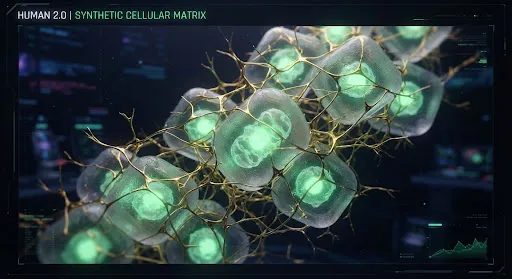
Project evolution — phase 7
A New Era of Human Evolution.
No Oxygen. No Limitation.
Human 2.0 is not an upgrade. It is a modular biological architecture designed for constant evolution throughout the cosmos.
Current status — stable evolution
- Bio-sync
- 99.8%
- Year lifespan
- 12K+
- ATP efficiency
- 10×
- Neural latency
- 1ms
Technical deep-dive
Systems Architecture
Four subsystems replace the failure points that make baseline human biology unsuitable for deep space.
-
Mitochondria 2.0
The Mitochondria 2.0 energy core removes dependency on haemoglobin and respiratory systems, eliminating the primary biological failure point for deep-space exploration.
- Input — extracts energy directly from water (H₂O).
- Catalyst — 2H₂O + energy (light / heat / EM) → 2H₂ + O₂.
- Transport — nanowires and synthetic enzymes move electrons to a quantum-dot matrix.
- Output — electron flow through nano-bio circuits generates ATP at 10× natural efficiency.
-
Plasma 2.0 — Synthetic Blood
Non-haemoglobin transport architecture carrying nano-particulate nutrient packets, with real-time DNA repair modules and zero coagulation risk in zero-G.
- Zero-G viscosity optimisation active.
- Integrated real-time DNA repair modules.
- No coagulation risk in microgravity.
-
Graphene-Neural Interface 2.0
Direct-to-neuron nanoscopic mesh providing 1ms latency for high-speed data uplinks and synaptic bridging.
- Latency — 1ms processing speed.
- Interface — graphene-based nanoscopic mesh.
- Uplink — high-speed neural data transfer.
-
Extreme Resilience
Operational integrity maintained across unprecedented thermal thresholds, for interstellar vacuum and oceanic depths alike.
- Low threshold — -200°C.
- High threshold — 300°C.
- Minimum gravity — 0.02G.
Baseline versus Upgrade
Comparing biological baseline (1.0) with enhanced evolution (2.0).
| System | Baseline (Human 1.0) | Upgraded (Human 2.0) |
|---|---|---|
| Lifespan | < 100 years | 10,000 – 12,000+ years |
| Energy system | Oxygen dependent (lungs) | Oxygen independent (Mitochondria 2.0) |
| Transport | Red blood cells / haemoglobin | Synthetic blood (Plasma 2.0 / nanobots) |
| Cognition | Biological baseline | Graphene-neural interface (20× intelligence) |
| Environment | Earth bound | Outer-space vacuum / extreme temperature |
Civilizational Continuity
By removing biological ageing triggers, we extend the individual perspective to a civilizational timescale — measured in millennia, not decades.
See the seven-phase roadmap