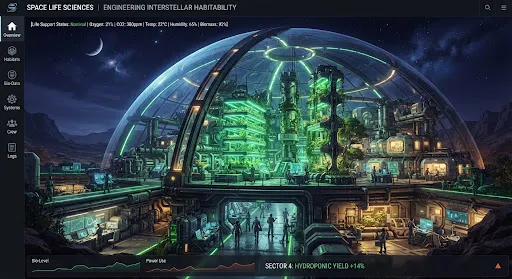
Sector: Deep Space Logistics
Engineering
Interstellar Habitability.
Closed-loop biological systems for multi-planetary survival. Pioneering the synthetic biospheres required for life beyond Earth.
- Stability index
- 99.84%
- Zero-G yield
- +142%
System Architecture
-
Closed-Loop Bio-Regeneration
High-efficiency biological processors that recycle 99.8% of H₂O and O₂, creating an autonomous atmospheric cycle for long-term off-world missions.
Patented BIO-04 ● Active -
Radiation Shielding Layers
Adaptive biological and magnetic shielding arrays designed to withstand solar particle events and GCR flux up to 10,000 Sv.
Patented MAG-S1 ● Operational -
Autonomous Habitat AI
Powered by SpaceLab™, our AI-governance node ensures real-time environmental balancing and early anomaly detection for crew safety.
Vernier L7 ● Synchronised
Intelligence node
The SpaceLab™ Architecture
Our unified data-collection core integrates biometrics, habitat stability metrics and resource flow into a single predictive engine. It doesn’t just monitor life; it anticipates the needs of the biosphere before they emerge.
- Habitat stability — multi-factor equilibrium monitoring
- Biological sync — circadian alignment with light-cycle protocols
- Resource efficiency — SupplySmart™ near-zero waste routing
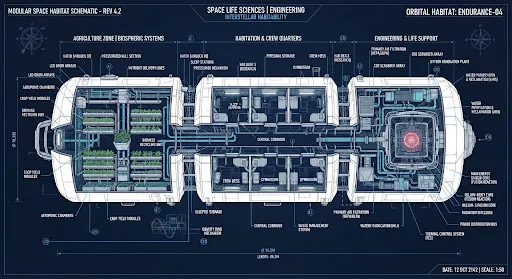
Operational Bounds
- Thermal resilience
- -200°C
- Radiation tolerance
- 10k Sv
- Min. gravity operability
- 0.02G
- MTBF threshold
- 1.2Ma
Initiate Strategic Deployment
Access the secure terminal for full deployment protocols and interstellar partnership frameworks.